When a connected camera is self-assessed under CRA Module A, five sets of evidence have to be in place: the SBOM, the risk assessment, the security test reports, the vulnerability handling process, and the technical documentation and declaration of conformity compiled from them.
This article follows on from “Can a Default Product Be Self-Assessed? Classifying a Connected Camera and the Documents It Needs” and covers the sticking points in the five steps, how ODMs differ from chip vendors, and the information to prepare before asking for a quote.
The five steps are set out in the table below; classification was covered in Part 1.
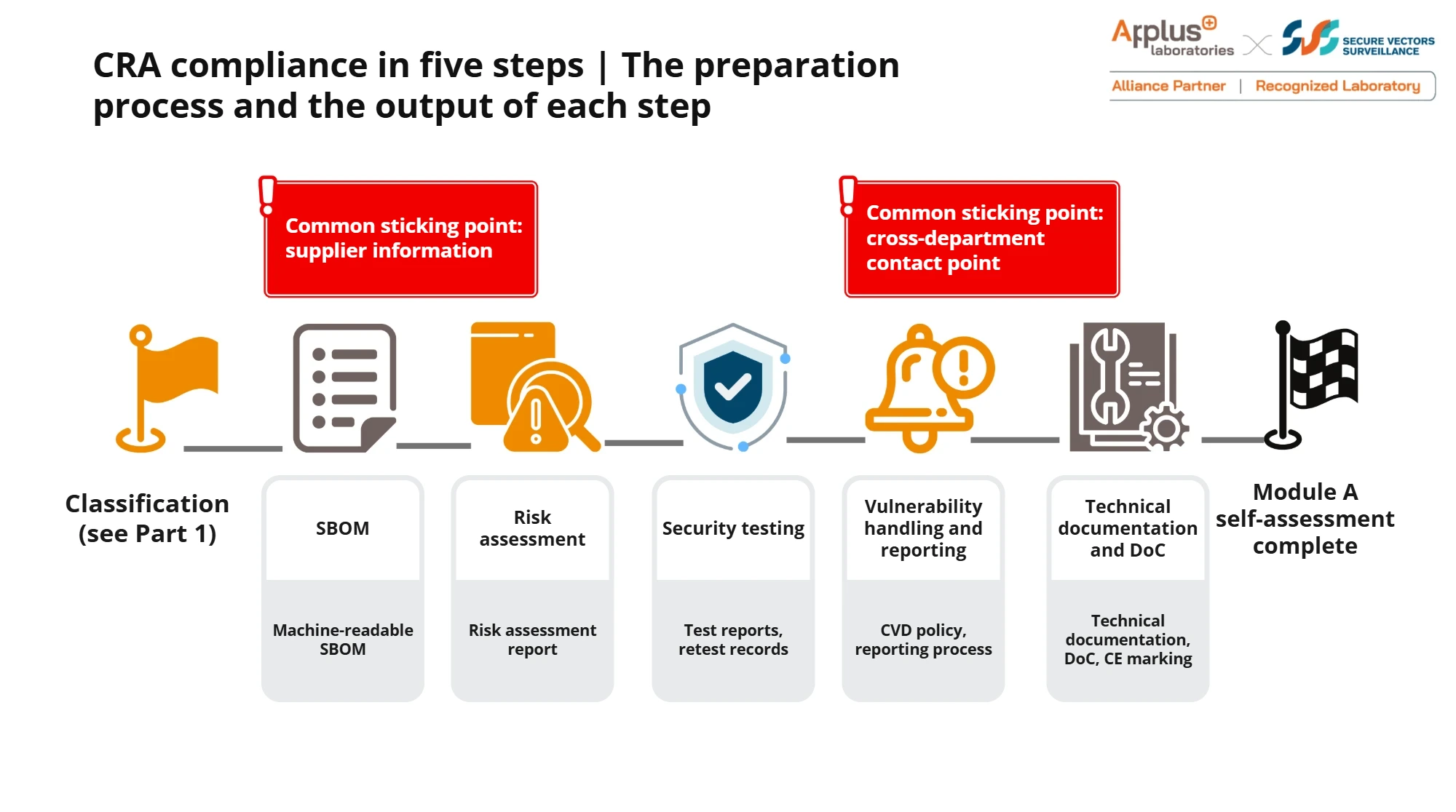
| Step | Mainly responsible | Common sticking points | Where the money goes |
|---|---|---|---|
| 1. SBOM | Firmware, ODM | Chip SDKs and module firmware are delivered as binaries, and suppliers do not provide a component list | Firmware analysis; back-and-forth with the ODM and chip vendors |
| 2. Risk assessment | Product, security | No ready-made architecture or data-flow diagrams | Organising documents; working through each interface |
| 3. Security testing | Security (with an external laboratory where needed) | The tested version differs from the shipping version; retest scheduling is hard to predict | Test scope; number of retest rounds |
| 4. Vulnerability handling and reporting | Customer service, product security contact, legal | No contact point across departments, so nobody can be reached within the 24-hour early warning deadline; the ODM does not cooperate on fixes | Setting up and rehearsing the process |
| 5. Technical documentation and DoC | Regulatory, quality assurance | The outputs of the first four steps are scattered across departments | Time to compile and review |
The SBOM has to cover the camera firmware (operating system, open-source libraries, Wi-Fi and BLE protocol stacks), supplier components (chip SDKs and module firmware, often delivered as binaries), and the cloud platform and mobile app. For the obligations and the depth required, see “SBOM Part 1” and “Part 2”. Sticking point: the ODM may not hold a complete SBOM, so it is advisable to specify the delivery format and update obligations in the contract.
The manufacturer must first carry out a cybersecurity risk assessment, then determine whether each Annex I requirement applies, recording the reasons where one does not. The method is to ask the same question of every interface: “If someone wanted to break in here, how would they do it?”
Sticking point: architecture and data-flow diagrams are often split between the ODM and the brand owner, so it is advisable to complete them first. Cameras are often installed where there is little physical control, so the assessment should include the risk of physical access.
Testing should respond to every threat in the risk assessment and cover five areas: firmware analysis, wireless interfaces (BLE, Wi-Fi), physical interfaces (USB-C, microSD, debug ports), the cloud and mobile app (OWASP can be used as a reference), and the secure update mechanism (signature verification and anti-rollback). Finding problems is common; retesting after fixes is advisable, and the test reports have to be included in the technical documentation (Annex VII, point 6).
Sticking point: the tested version should match the shipping version, fixes depend on the ODM supplying new firmware, and time should be set aside for retesting. Applus+ Laboratories warns that a rush of submissions in the final stage may create a capacity bottleneck (further reading: iThome, “15 months to go until the CRA applies in full: Spain’s Applus+ Laboratories explains the latest on harmonised standards and notified bodies, and urges Taiwanese companies to start product classification and compliance preparation early” (in Chinese)).
Annex I Part II requires a continuing capability after the product is on the market: a vulnerability disclosure contact point, an internal handling process (with the SBOM updated at every firmware release) and a reporting mechanism. Actively exploited vulnerabilities, and severe incidents having an impact on the security of the product, require an early warning within 24 hours and a notification within 72 hours, followed by a final report within the set deadlines (Article 14(2) and (4)); see our articles “Inside CRA Article 14 Reporting Obligations” and “Building the Internal SOP for CRA Article 14”. This obligation has applied since 11 September 2026 and covers products placed on the market before 11 December 2027 as well; for those existing products, the remaining requirements apply only if a substantial modification is made after that date (Article 69(2) and (3)).
The support period has to reflect the expected period of use and is in principle at least 5 years; where the product is expected to be in use for less than 5 years and there are grounds for this, the support period follows the expected period of use (Article 13(8)). The support periods of third-party core components must also be taken into account and recorded in the technical documentation; it is advisable to cross-check upstream support periods with the ODM and chip vendors.
Default products need this too. Module A only means that no Notified Body is needed; the manufacturer still has to prepare the Annex VII technical documentation, sign the declaration of conformity (DoC) and affix the CE marking (Annex VIII Part I). The outputs of the first four steps are compiled into the Annex VII technical documentation: the product description, design and vulnerability handling processes, risk assessment, basis for the support period, a description of the standards applied and of alternative solutions, test reports and a copy of the DoC. The SBOM has to be included in the technical documentation and provided when an authority makes a reasoned request. The technical documentation and the DoC are kept for at least 10 years or the support period, whichever is longer (Article 13(13)).
No CRA harmonised standard has yet been published in the Official Journal. EN 40000-1-1 and 1-2 were approved by CEN as European standards in November 2026 but are not expected to be cited in the Official Journal; 1-3 (vulnerability handling) is still in the approval stage, and 1-4 (generic security requirements) is still being drafted. In practice, EN 40000-1-2, the draft prEN 40000-1-3 and EN 18031 can serve as the technical baseline for now (for the progress of the standards, see the references). These bases must be recorded accurately in the technical documentation, noting that they are not yet harmonised standards, because Annex VII point 5 requires a description of the solutions adopted.
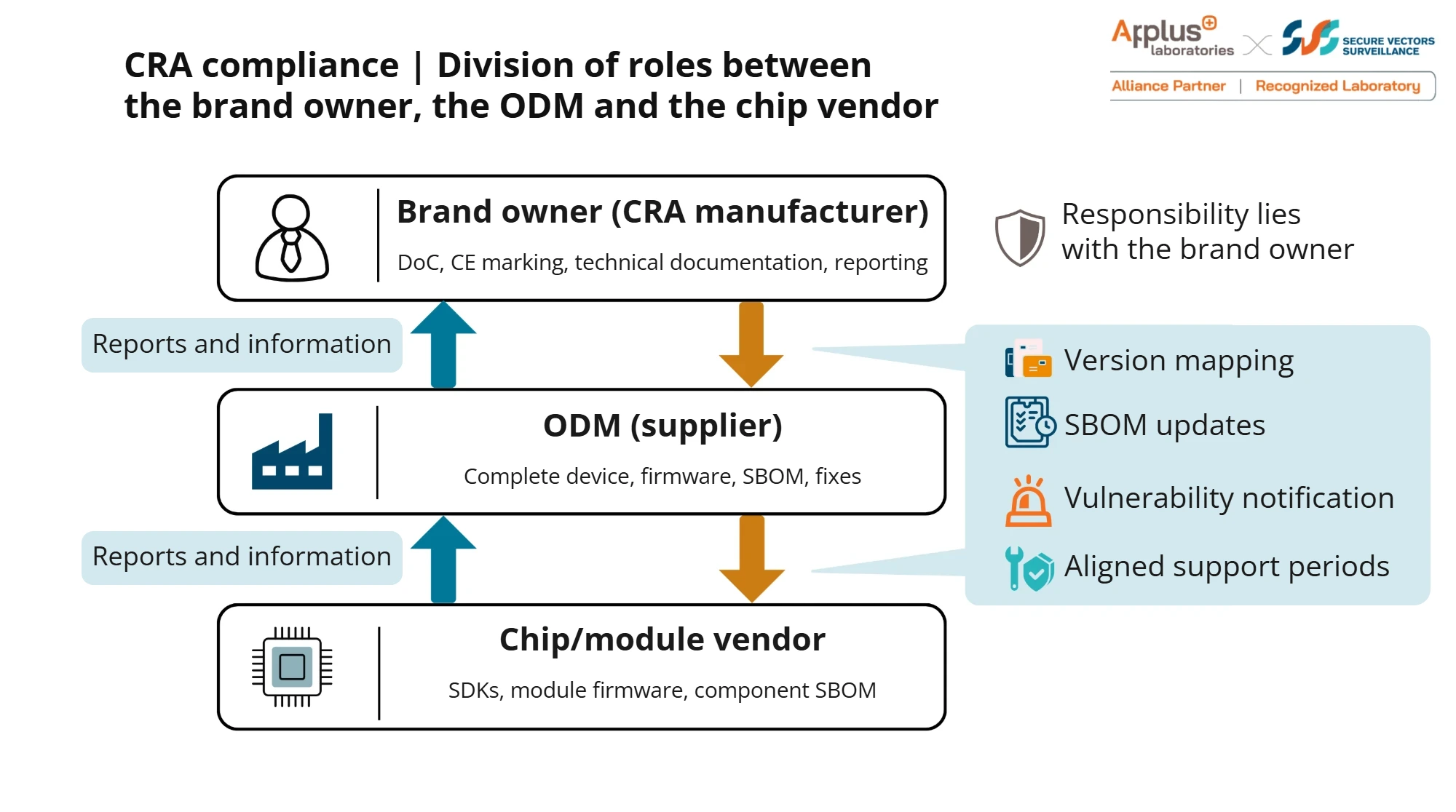
Most brand owners do not design and manufacture their connected cameras themselves; they commission an ODM (Original Design Manufacturer). The three roles differ as follows:
| Role | Who it is | What it provides | What it means under the CRA |
|---|---|---|---|
| Brand owner | The company placing the product on the market under its own name or trademark | The whole product | The CRA manufacturer, responsible for the DoC, CE marking, technical documentation and reporting |
| ODM | Designs and manufactures the whole camera for the brand owner | Complete device, firmware, mobile app (if supplied by the ODM), SBOM, fixes | Supplier; its reports can serve as input |
| Chip/module vendor | Supplies processors, Wi-Fi/BLE modules and SDKs | Components and development kits | Component supplier; its reports cover only the components |
The difference: the ODM delivers the whole product, so its reports are closer to the complete device but tied to the ODM’s base firmware; the chip vendor delivers components, so its reports can only demonstrate the component itself and cannot stand for the whole camera.
In addition, from 11 December 2027 modules and chips sold separately must themselves comply with the CRA and carry the CE marking. When exercising due diligence under Article 13(5), the brand owner can check whether a component carries the CE marking, whether it is still receiving security updates and whether it has known vulnerabilities, and test it separately where necessary.
Once you have the ODM’s reports, it is advisable to check the following details:
| Common assumption | Details to check | Risk if not checked |
|---|---|---|
| “The supplier has a test report” | Which standard is the report based on? EN 18031 addresses RED provisions, not the CRA | The report cannot be used directly as CRA evidence |
| “The report is for this model” | Do the firmware and hardware versions tested match the shipping version? | Once the brand owner customises the firmware, the report no longer matches the actual product |
| “The report covers the whole product” | Were the cloud platform and mobile app within the test scope, or was only the camera itself tested? | The cloud platform or mobile app is left out of the assessment, leaving a gap in the scope |
| “The ODM will keep supporting it” | Do the ODM’s and chip vendors’ support periods cover the support period the brand owner declares? Does the contract include clauses on vulnerability notification and cooperation on fixes? | Upstream support ends and the brand owner cannot keep its commitment; information cannot be obtained within the reporting deadlines |
The key to saving cost usually lies in the contract: agreeing report delivery and version mapping, SBOM updates, vulnerability notification and cooperation on fixes, and aligned support periods is usually more efficient than retesting after the fact.
A product description on your website is not enough for an accurate price: the website shows the appearance, interfaces and functions, but the workload depends on things the website does not show. Before asking for a quote, it is advisable to have the following ready:
| Information | Why it affects the quote |
|---|---|
| Model and firmware version | Tests and reports are tied to a specific version; a different version may need retesting |
| System architecture and list of interfaces | Determines the scope of the risk assessment and testing |
| Scope of the cloud platform and mobile app, and who operates them | Determines whether the cloud and app are included, and whom to work with |
| SBOM and existing reports supplied by the ODM | Determines how much can be reused and how much additional testing is needed |
| Planned launch date and target markets | Affects scheduling, the number of retest rounds and the assessment route |
A website product description can be used for a preliminary assessment (classification, inventory of interfaces and scope, list of work items), but is not enough to base an accurate quote on.
What a default product saves is the Notified Body’s review, not the burden of proof. The core of the work is to take stock, in one pass, of your product, the components supplied by the ODM and chip vendors, and the cloud platform and mobile app.
If you already have the information in the table above ready, or need to confirm whether an existing EN 18031 report can be reused for the CRA, you are welcome to contact SV Surveillance; we will set out the items to be tested and the next steps. Find out more about EU CRA services or EN 18031 testing services.
Not necessarily. The CRA does not require testing of default products to be carried out by a third party or an accredited laboratory. The manufacturer (the brand owner placing the product on the market under its own name) can test the product itself, but the technical documentation must include the test reports (Annex VII, point 6), and Annex I Part II point 3 also requires effective and regular tests and reviews; it is advisable to keep a record of the method, scope and firmware version. If you only have component-level information, such as for the chip or module, or are unsure what to test, you can commission an external laboratory to define the test scope and carry out whole-device testing; responsibility remains with the brand owner.
No, that is not enough. The website shows the external interfaces and the scope of the cloud and app, but not the firmware composition, the relationship with the ODM and chip vendors, who operates the cloud or what reports already exist — and these determine the workload. A preliminary assessment (classification, scope inventory, list of work items) can be done first; a formal quote needs the full information.
By Secure Vectors Surveillance × Applus+ Laboratories
* This article is regulatory commentary, not legal advice. The CRA harmonised standards timetable and the designation of notified bodies continue to move; the final compliance determination in any individual case should rest on official EU documents and the interpretations of the competent authorities.