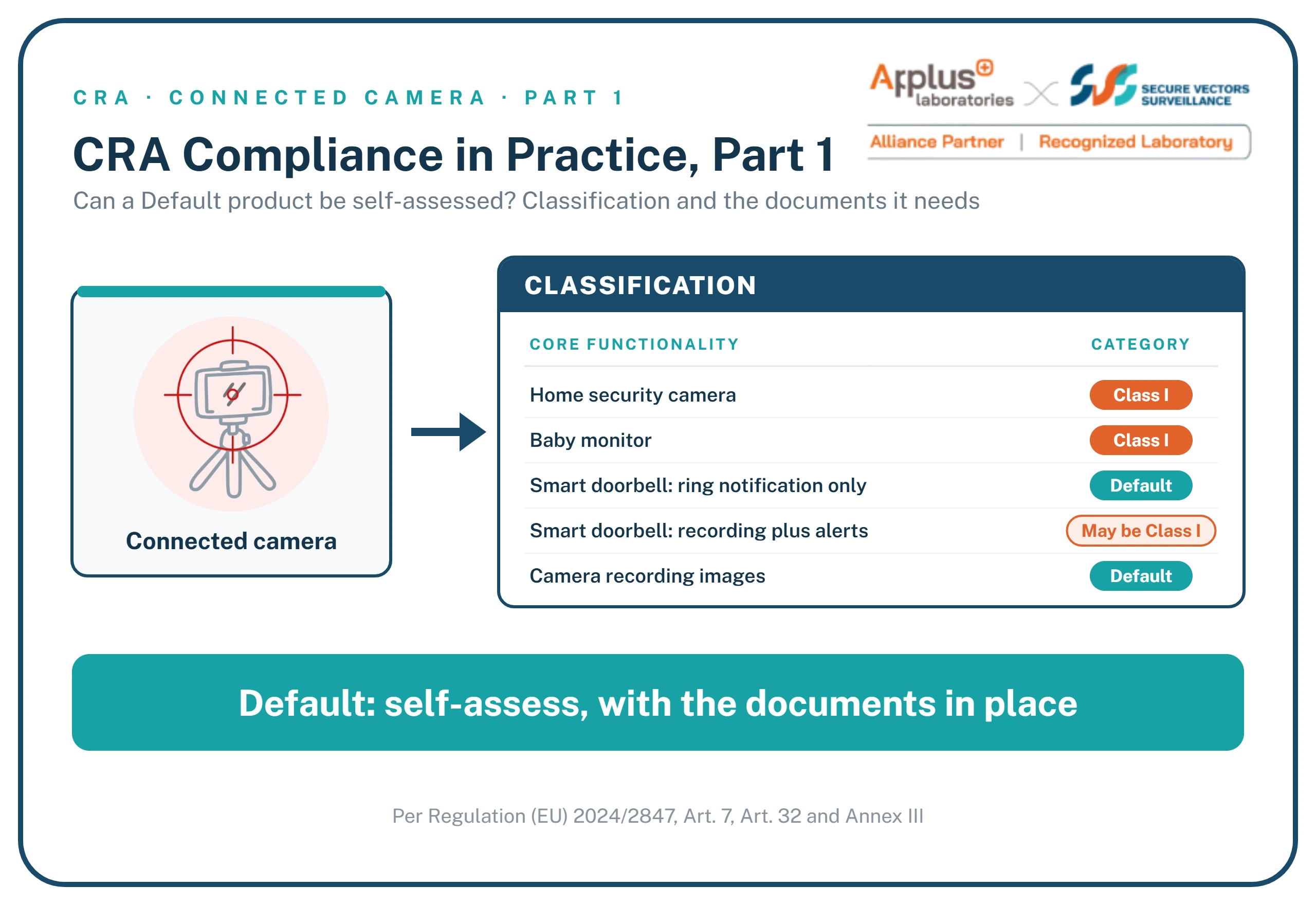
A Default product does not need a Notified Body: the manufacturer can assess it and declare conformity itself (Module A). That does not mean there is nothing to prepare: the technical documentation, the test evidence and the EU declaration of conformity all have to be complete and kept, and must be produced when a market surveillance authority makes a reasoned request.
This article takes as its example a cloud-managed connected camera used to record images. Part 1 explains how to determine the classification and the assessment scope, which documents need to be in place, and what happens when the documentation is incomplete. Part 2, “Completing a Connected Camera’s Documentation: Five Steps, Sticking Points and Checking ODM Reports” explains how to assemble the evidence step by step. The reporting obligations of the EU Cyber Resilience Act (CRA) have applied since 11 September 2026; the remaining requirements apply in full from 11 December 2027.
The Regulation itself contains no term “Default”. It is industry shorthand for an ordinary “product with digital elements” (products with digital elements; hereafter a default product): one that is neither an important product listed in Annex III nor a critical product under Annex IV. Such products can be self-assessed under Module A (internal control). For the full picture of the four tiers, see our article on CRA product classification.
Under Module A the manufacturer carries out the assessment itself and, as Annex VIII puts it, declares conformity on its sole responsibility. The assessment covers both the product and the manufacturer’s processes.
The technical documentation and the DoC must be kept for at least 10 years or for the support period, whichever is longer (Article 13(13)); on a reasoned request from an authority, the information demonstrating conformity must be provided in a language the authority can easily understand (Article 13(22)). The real risk for a default product is often not “failing a test” but “being unable to produce the evidence”. For what happens when the documentation is incomplete, see the section “What happens if you cannot produce the evidence?” in this article.
Once you have confirmed that the product falls within the CRA (see our article on scope), look first at its core functionality, not at the functions it is “capable of” (Implementing Regulation (EU) 2025/2392). Under the technical description in point 17 of Annex I to Implementing Regulation (EU) 2025/2392, Class I item 17 of CRA Annex III (smart home products with security functionalities) means products that protect the physical security of consumers in a residential setting and can be controlled or managed remotely by other systems; the examples given include home security cameras and baby monitors. Note that the category name in Annex III item 17 itself lists security cameras, so the decisive question is not whether the product can record video, but whether it is used in a residential setting with protecting consumers’ physical security as its core functionality. The example in this article is a connected camera intended for recording images, not for residential security.
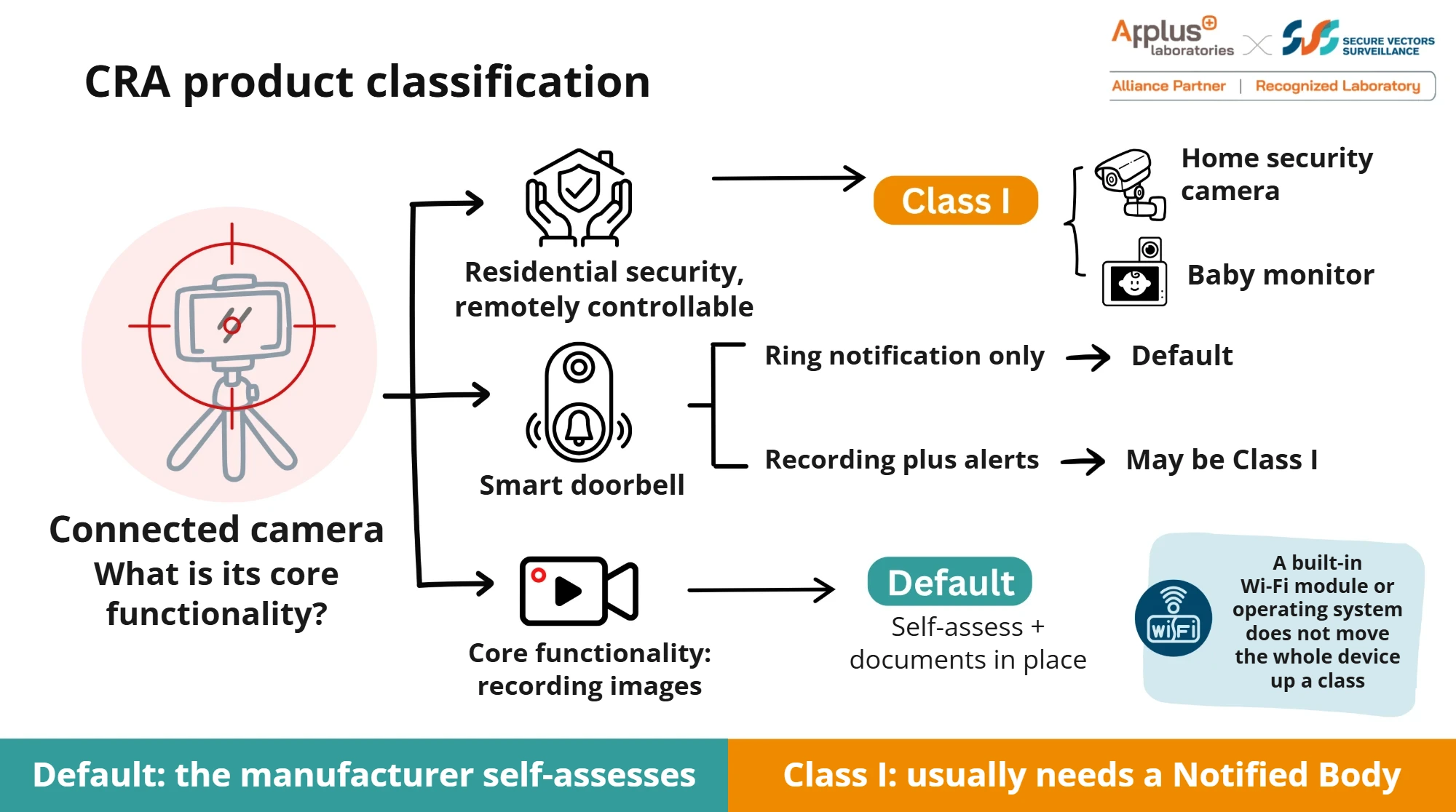
Connected camera use cases and their CRA classification
| Use case | Possible classification | Notes |
|---|---|---|
| Residential security cameras, baby monitors | Class I | Examples named in item 17 |
| Home cameras linked to alarms or door locks, and their hubs and apps | Class I | Item 17 covers the software and hardware that centrally control such products |
| Smart doorbell | Depends on the core functionality | Ring notification only: default product; recording plus alerts: may fall under item 17 |
| Access-control reader with biometrics | Class I | Item 1 |
| Connected camera intended for recording images (this article’s example) | Default product | Not for residential security; does not match the item 17 technical description |
| Wi-Fi/BLE modules and security chips sold separately | Class I, Class II or critical product | The module and chip vendors’ own obligations; secure elements are Annex IV critical products |
Wi-Fi/BLE modules and security chips sold separately may themselves be Class I — so if a camera has these parts built in, does the whole camera move up too? Common parts inside a connected camera are indeed listed in Annex III: Wi-Fi and BLE modules are network interfaces (item 10), the boot manager falls under item 8, the embedded operating system under item 11, and processors or microcontrollers with security-related functionalities under items 13 and 14. Hence the argument some people make: a camera containing Class I parts is itself Class I.
The answer is no. Recitals (2) and (3) of 2025/2392 explain that CRA classification looks at the core functionality of the product as a whole; the components it contains do not move the whole device up a class. Recital (5) uses smartphones as an example: a smartphone contains an operating system and a password manager, but those are not its core functionality, so it is generally not regarded as falling into those categories. The same logic applies to a connected camera with a built-in Wi-Fi module and boot manager.
That does not mean the built-in components can be ignored. Under Recital (3), the manufacturer still has to assess the security of the product as a whole, taking into account the security of the components it integrates. In addition, the intended purpose includes what is stated in the instructions for use, promotional and sales materials and the technical documentation (Article 3(23)), so the descriptions on the website and in the manual should match the actual functionality and be consistent with the basis for the classification.
The manufacturer determines the classification itself. The CRA has no prior approval mechanism; whether the classification is correct is examined by market surveillance authorities after the product is placed on the market, and a wrong classification amounts to using the wrong assessment procedure. It is advisable to record the basis for the classification in writing and keep it consistent with the description of the intended purpose in the technical documentation.
A default product is assessed and declared by the manufacturer itself, with no Notified Body. For Class I it depends on whether a harmonised standard or another basis has been applied in full: the product may be self-assessed, or a Notified Body may have to be involved.
No CRA harmonised standard has yet been published in the Official Journal of the European Union, so at this stage Class I will in most cases need a Notified Body; plan for it early. This article assumes a default product; for the Class I route, see “How Does CRA Conformity Assessment Work? Comparing Modules A, B+C and H”.
The example in this article is a cloud-managed connected camera used to record images. The camera has four external interfaces — BLE, Wi-Fi, USB-C and microSD — and comes with a cloud management platform and a mobile control app. The camera itself and its four interfaces are clearly within the assessment scope; what needs clarifying is the cloud platform and the mobile control app.
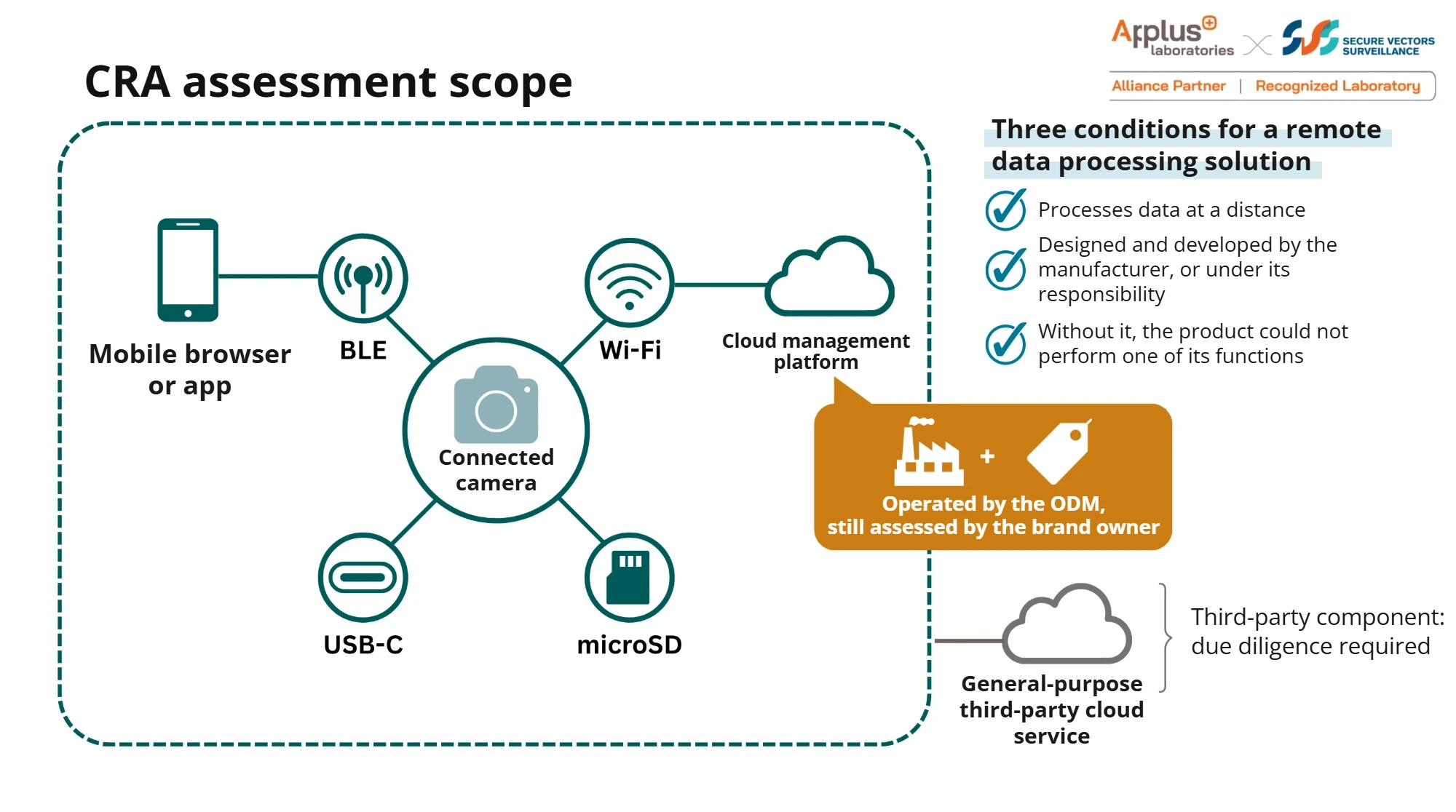
Whether the cloud platform is included in the assessment depends on whether it is a remote data processing solution within the meaning of Article 3(2), which requires all three conditions to be met: it processes data at a distance; its software is designed and developed by the manufacturer, or under its responsibility; and without it the product could not perform one of its functions. What decides it is who developed the software and under whose responsibility, not who operates it.
In this article’s example, the cloud management platform was developed for the brand owner by the ODM (the company that designs and manufactures the whole product for the brand owner; more in Part 2) and is provided under the brand owner’s name, and without it the camera cannot be viewed or managed remotely. So even though the ODM operates it day to day, it has to be included in the brand owner’s assessment scope. Conversely, a general-purpose third-party cloud service (such as public cloud hosting) is usually not a remote data processing solution, but the manufacturer must still exercise due diligence on such third-party components under Article 13(5).
The mobile control app has to be included in the assessment scope as well. Under section 2.4 of the European Commission’s CRA guidance (C/2026/6013), software necessary to operate, configure, control or use a product is part of the product itself, even when it is downloaded separately through a channel such as an app store. The app is installed and runs on the user’s phone and is not a remote data processing solution, so the three conditions above do not apply; it is treated directly as part of the product.
In this article’s example, the user has to complete Bluetooth pairing and set-up through the app, so the app and the camera together form a single product and have to be included together; third-party libraries used in the app also have to be listed in the SBOM. If the camera is instead controlled through a web page opened in the phone’s browser, the web page itself is not a product, and the three conditions above apply again: decide whether to include it in the same way as for the cloud platform.
A default product has to do the same as any other product, with Annex I as the benchmark: 13 product requirements plus 8 vulnerability handling obligations. Carry out a risk assessment first, then determine whether each requirement applies, recording the reasons where one does not (Article 13). For an item-by-item explanation and six first steps, see our article “Breaking Down CRA Annex I”. For a connected camera, the points that most often need evidence are the attack surface of the external interfaces ((j), such as a USB-C debug port) and data deletion ((m), microSD and cloud video).
Self-assessment has no Notified Body as gatekeeper, so the risk assessment and the technical documentation are the only basis on which to explain to the authorities “why what we did is enough”. After self-assessment, a default product needs at least the following four documents and markings:
Once the scope is settled, the next step is to take stock of which existing evidence can be reused. For a connected camera with Wi-Fi and BLE, the most common existing evidence is an EN 18031 report. The cybersecurity requirements of the RED (Radio Equipment Directive) were activated by Delegated Regulation (EU) 2022/30, and since 1 August 2025 radio equipment sold in the EU has had to comply with them; EN 18031 is the harmonised standard for that delegated regulation. Under Delegated Regulation (EU) 2026/339, 2022/30 is repealed from 11 December 2027; products placed on the market after that come under the CRA instead, and EN 18031 no longer gives presumption of conformity under the RED.
The CRA sets no fixed number of days for supplying missing documents; the authorities deal with each case individually:
| Stage | Article | Key points of the text |
|---|---|---|
| Request for documents | Articles 13(22) and 53 | On a reasoned request, information demonstrating that the product and processes conform to Annex I must be provided; authorities can also obtain data, including internal documents |
| Formal non-compliance | Article 58 | Where, for example, the technical documentation is unavailable or incomplete, the authority requires the non-compliance to be brought to an end; if it persists, the product is restricted on the market, or recalled or withdrawn |
| Substantive concern | Article 54 | Where there is a significant cybersecurity risk, the authority sets a reasonable period for corrective action; once it has passed, provisional measures are taken |
Supplying incorrect, incomplete or misleading information is in itself a separate infringement (Article 64(4)).
Part 2, “Completing a Connected Camera’s Documentation: Five Steps, Sticking Points and Checking ODM Reports” explains how to assemble the evidence.
If your product needs CRA- or EN 18031-related services — whether classification, a review of existing reports, or risk assessment and testing — you are welcome to contact SV Surveillance; we will set out the items to be tested and the next steps. Find out more about EU CRA services or EN 18031 testing services.
If it is intended for recording images and not for residential security, it tends to be a default product. If it is used in a residential setting, its core functionality is protecting the physical security of consumers and it can be controlled or managed remotely (such as a home security camera), it is a Class I product under Annex III item 17. Classification follows the core functionality and the intended purpose; built-in components do not move the whole device up a class. It is advisable to record the reasons for the classification.
The CRA sets no fixed number of days for supplying missing documents; it depends on how the authority handles the case. If the technical documentation is merely unavailable or incomplete, under Article 58 the authority will first require the manufacturer to bring the non-compliance to an end; only if it persists may the product be restricted on the market, or recalled or withdrawn. If the authority considers that the product presents a significant cybersecurity risk, under Article 54 it will require corrective action within a reasonable period that it sets according to the nature of the risk. In addition, information supplied to the authority that is incorrect, incomplete or misleading is in itself a separate infringement (Article 64(4)), so when supplying missing documents, state the facts accurately; it is advisable to propose a timetable for the corrections at the same time.
The CRA governs products placed on the EU market and has no legal force in Taiwan. However, if the same product shares firmware and vulnerability handling processes across markets, the EU requirements may benefit other markets indirectly; that depends on what the manufacturer does and is not guaranteed by law. Note too that the CRA does not mean a product is absolutely secure: what it requires are essential cybersecurity requirements and vulnerability handling processes, and a default product is assessed by its own manufacturer. For products placed on the market before 11 December 2027, apart from the reporting obligations, the remaining requirements apply only if the product undergoes a substantial modification (Article 69).
By Secure Vectors Surveillance × Applus+ Laboratories
* This article is regulatory commentary, not legal advice. The CRA harmonised standards timetable and the designation of notified bodies continue to move; the final compliance determination in any individual case should rest on official EU documents and the interpretations of the competent authorities.