

Since 1 August 2025, wireless products such as Bluetooth earbuds, smart plugs, payment terminals and children's smartwatches have had to meet the new cybersecurity requirements of the EU Radio Equipment Directive (RED) when they are placed on the EU market. EN 18031 is the harmonised standard the EU has recognised for showing that a product meets those requirements.
This guide sets out the essentials of EN 18031 in six questions: what the standard covers, who it applies to, who is involved, how the process runs, how long it takes and what it costs. To check which parts apply to your product, or to see the 8-step testing process and the pre-submission checklist, visit our EN 18031 testing page.
Key points
- Since 1 August 2025, wireless products placed on the EU market have been subject to the RED cybersecurity requirements according to their functions. EN 18031 has three parts: -1 network protection, -2 personal data protection and -3 protection of financial assets. More than one can apply to the same product.
- Products that apply the standard in full and are not touched by its restrictions can self-declare. Where a restriction applies (for example, users may skip setting a password, a children's product does not ensure parental access control, or the secure-update criteria of -3 apply), a Notified Body must be involved in the assessment.
- The lab tests the product and issues the test report; certificates are issued by the Notified Body. Time and cost depend mainly on the product's architecture.
- Some of the test evidence is expected to serve as groundwork for the CRA, which applies in full from 11 December 2027.
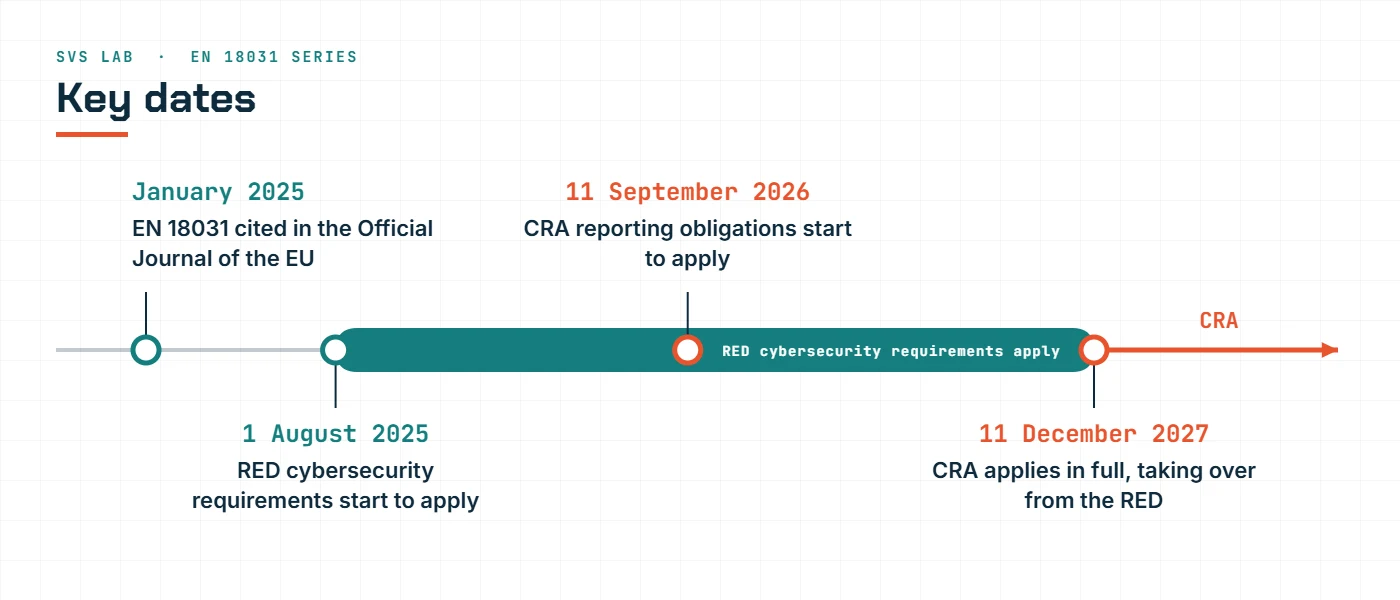
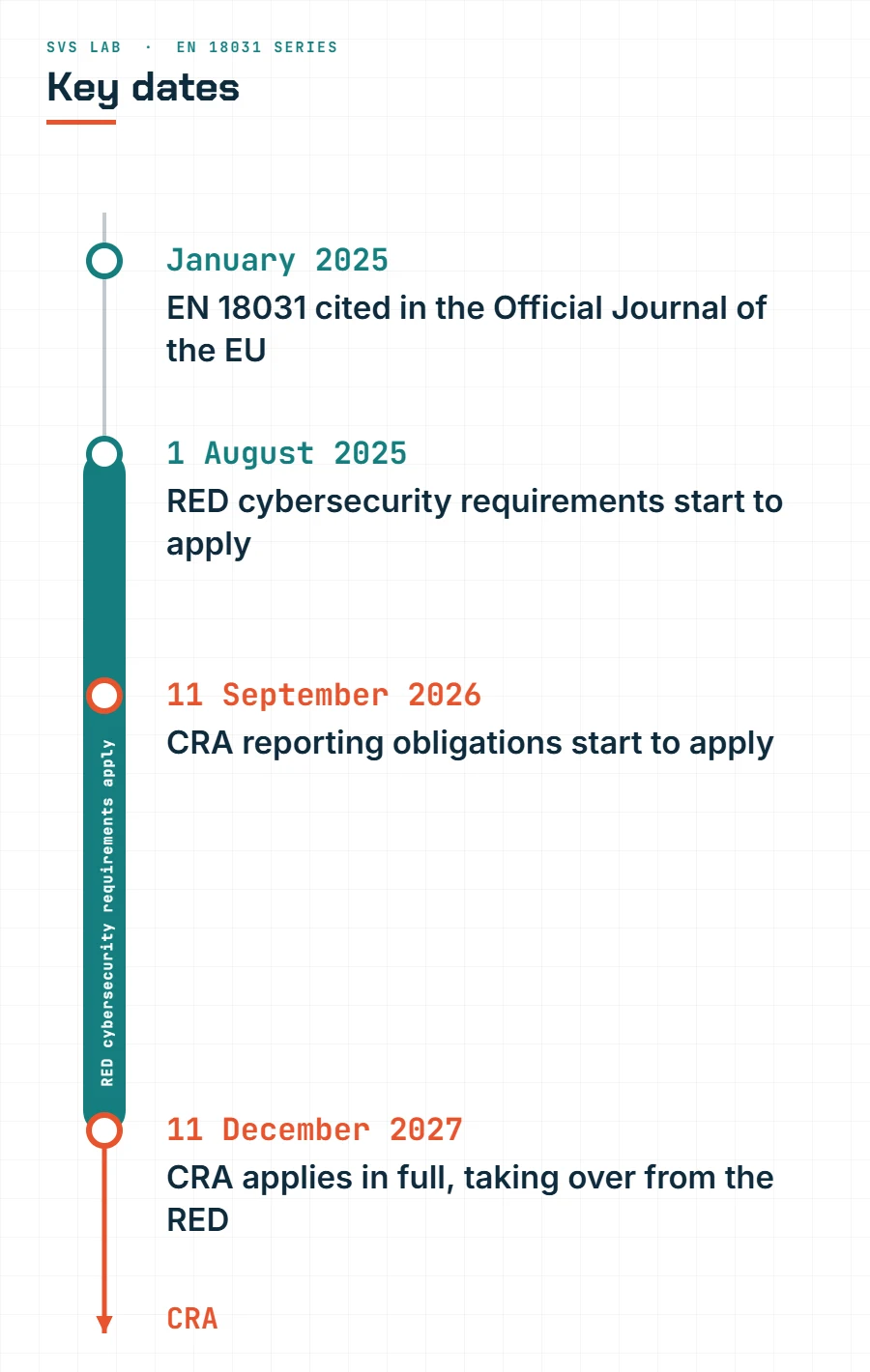
Until 11 December 2027, EN 18031 is the main basis for showing conformity with the RED cybersecurity requirements. The CRA reporting obligations have already applied since 11 September 2026.
01What is EN 18031?
EN 18031 is a harmonised standard recognised by the EU for showing that wireless products meet the three cybersecurity requirements of the RED.
Since 1 August 2025, Delegated Regulation (EU) 2022/30 has switched on three requirements of the RED, in Article 3(3)(d), (e) and (f). In plain words: the product must not harm the network it connects to, must protect personal data and privacy, and must protect against financial fraud.
EN 18031 is a harmonised standard: a technical standard the EU has formally accepted for showing compliance with the law. The RED cybersecurity requirements are mandatory; EN 18031 is one way of showing that a product meets them. If your product meets the standard, the authorities presume it meets the law. This is called the “presumption of conformity”. Where the standard is not applied, or applied only in part, a Notified Body has to be involved in the assessment instead (see section 03).
The three parts and what they cover
Radio products that can communicate over the internet, directly or via another device
Internet-connected products that can process personal data, plus toys, childcare products and wearables (these three even without an internet connection)
Internet-connected products that let users transfer money, monetary value or virtual currency
The requirements add up rather than replace one another: an internet-connected product that processes personal data falls under -1 and -2; one that handles financial transactions falls under -3 as well.
What EN 18031 assesses
EN 18031 assesses whether a product can prevent unauthorised access and tampering. It does not assess the physical harm that tampering could cause the person using it.
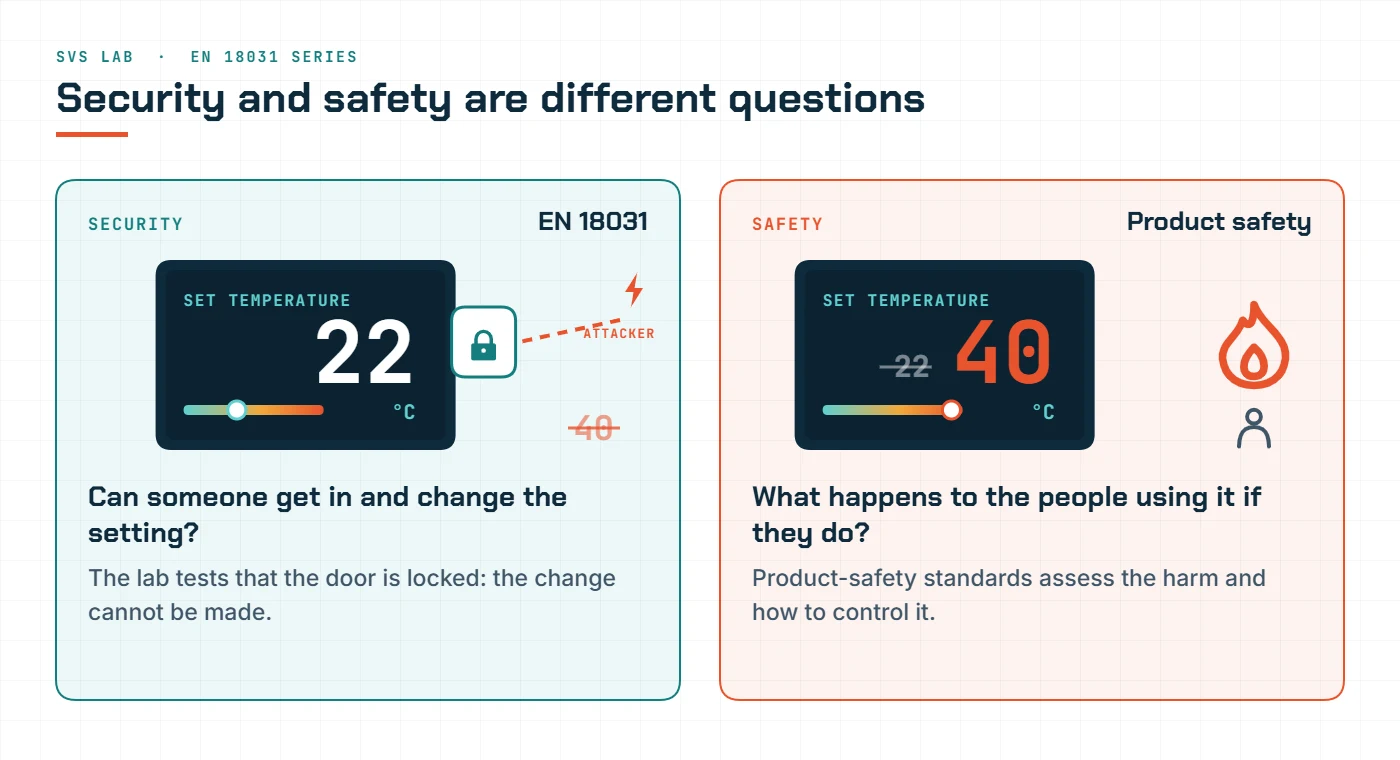
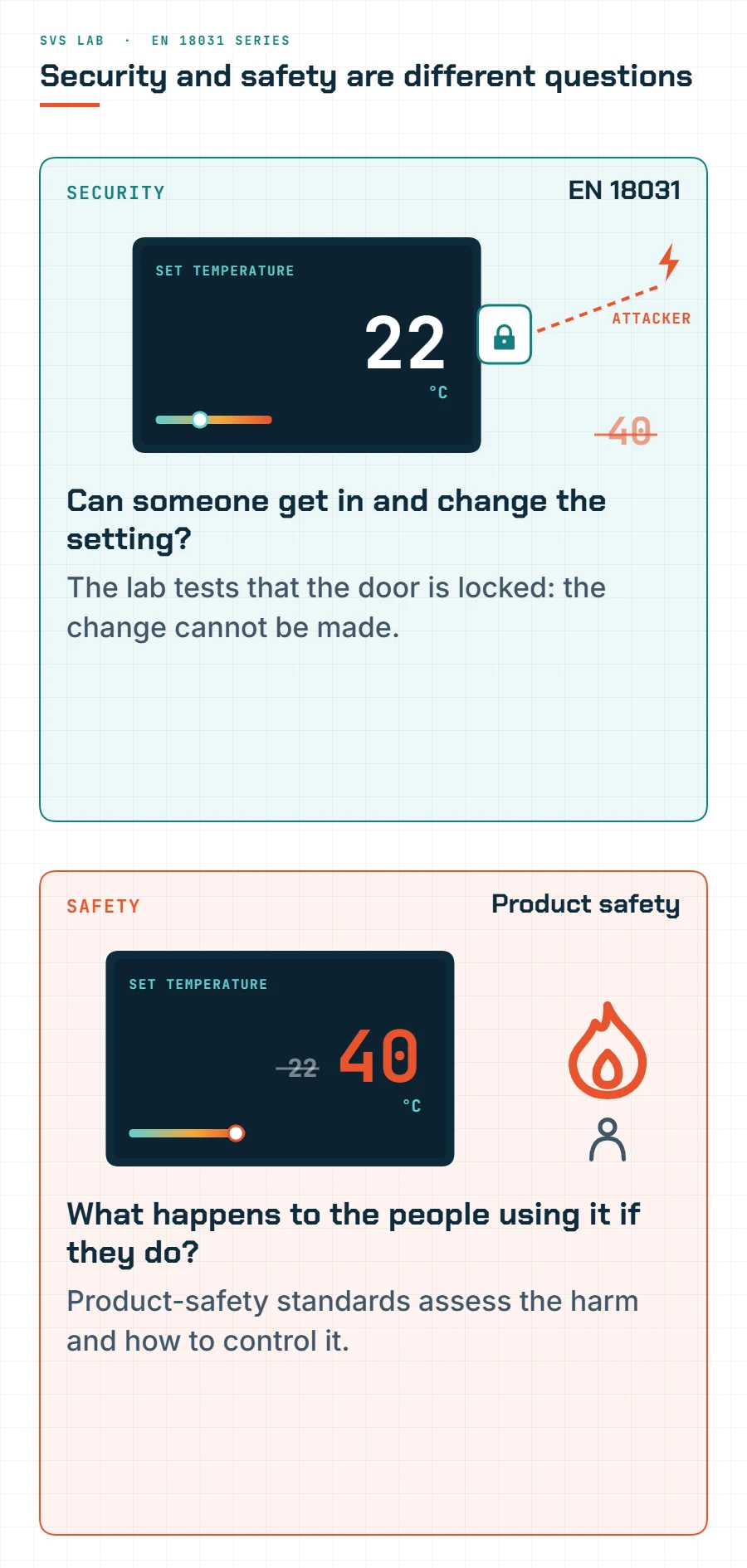
Take a connected heater. If an attacker could change its temperature setting from 22 °C to 40 °C, a security flaw would turn into a physical risk. EN 18031 assesses whether such tampering is effectively blocked. What harm the change could cause is a product-safety question, handled by the safety rules for each product category. A connected product needs to meet both.
02Who needs it?
Whether a wireless product sold on the EU market from 1 August 2025 has to meet the RED cybersecurity requirements depends on its functions.
First, check whether your product is in scope
- Does the product have wireless functions (Bluetooth, Wi-Fi, mobile network, NFC and so on), and is it sold in the EU?No: it is outside the scope of the RED cybersecurity requirements. Yes: go on to questions 2–4.
- Can it connect to the internet, directly or via another device?Yes: EN 18031-1 applies. A product that connects over Bluetooth to a phone app, which then goes online, also counts.
- Can it process personal data (including traffic and location data)?Internet-connected products: EN 18031-2 applies. Childcare products, toys and wearables also fall under it if they can process personal data, even without an internet connection.
- Can it let users transfer money, monetary value or virtual currency?Internet-connected products: EN 18031-3 applies.
The requirements add up, so more than one part can apply to the same product. For an interactive version, try the four-question applicability check on our testing page.
Who has obligations
The RED sets separate obligations for manufacturers, importers and distributors:
Manufacturers (Article 10)
When placing a product on the market, they must ensure it is designed and manufactured in line with the essential requirements; carry out the conformity assessment, draw up the technical documentation, sign the EU Declaration of Conformity (EU DoC) and affix the CE mark.
Importers (Article 12)
May place only compliant products on the market. Before doing so, they must check that the manufacturer has carried out the conformity assessment and drawn up the technical documentation, and that the product bears the CE mark and comes with the required documents.
Distributors (Article 13)
Must act with due care in relation to the RED requirements when making a product available on the market. Before doing so, they must check that the product bears the CE mark and comes with the required documents.
An importer or distributor that places a product on the market under its own name or trademark, or modifies a product in a way that may affect compliance, takes on the manufacturer's obligations. When a Taiwanese company manufactures for an EU brand (OEM/ODM), the legal manufacturer is usually the brand owner, but brand owners usually ask the contract manufacturer for test reports and technical documentation. A manufacturer outside the EU may appoint an EU authorised representative to hold the technical documentation and answer requests from the authorities.
Two common misconceptions
- “Our model is already on the market”: The RED cybersecurity requirements attach to the date each unit is placed on the EU market, not to the date the model was first launched. Units of an existing model that are placed on the market after 1 August 2025 have to comply too.
- “Medical devices have to do it too”: The following products are excluded from the RED cybersecurity requirements:
- medical devices regulated under the MDR/IVDR: excluded from all three requirements;
- equipment covered by the rules on civil aviation, vehicle type-approval and electronic road tolling: excluded from personal data protection and financial asset protection; the network protection requirement still applies.
03Who does the testing and certification?
Responsibility for compliance stays with the manufacturer. Two outside parties can take part: the test laboratory and the Notified Body. Their roles differ, and one cannot stand in for the other.
Test laboratory
Tests the product and issues the test report
Tests the product against EN 18031 and issues a report; it does not issue certificates. Accreditation to ISO/IEC 17025 means its testing competence has been assessed by a third party.
Notified Body (NB)
Carries out conformity assessment and issues certificates
An independent organisation designated by an EU Member State. Each has a four-digit number and a defined scope, which can be checked in the EU's NANDO database; for example, Applus+ Laboratories (NB 0370, a RED Notified Body).
A Notified Body is not always needed
Under Article 17 of the RED, a manufacturer that applies harmonised standards cited in the Official Journal of the EU can self-declare (internal production control), or can choose to involve a Notified Body. Where harmonised standards are not applied, or applied only in part, a procedure involving a Notified Body is required.
When EN 18031 was cited in the Official Journal under Implementing Decision (EU) 2025/138, restrictions were attached. If any of them applies to a product, that part of the standard gives no presumption of conformity for the legal requirement it covers, and a Notified Body must be involved in the assessment. Three matter in practice:
- the product lets users skip setting or using a password (a restriction in EN 18031-1, -2 and -3);
- a toy or childcare product does not ensure parental or guardian access control (EN 18031-2);
- the product falls under EN 18031-3: the assessment criteria for its secure-update mechanism give no presumption of conformity, so a Notified Body must be involved in the assessment.
| Self-declaration possible | Notified Body needed | |
|---|---|---|
| When it applies | The relevant parts of EN 18031 are applied in full and no restriction is involved | A restriction is involved, or the standard is not applied in full |
| Testing | The law does not require a laboratory; commissioning an ISO/IEC 17025 laboratory gives you a third-party test report for the technical documentation | The lab's report is available to the Notified Body as supporting evidence for its review |
| Certificate and declaration | No certificate needed; the manufacturer compiles the technical documentation, signs the EU DoC and affixes the CE mark | The Notified Body assesses the product and issues the certificate; the manufacturer still signs the EU DoC |
Choosing a laboratory and a Notified Body
Check the following, in this order:
- First, check whether a Notified Body is needed: Based on the criteria above, if a restriction may apply to your product, take the Notified Body into account from the start.
- Notified Body: check its scope: Confirm in NANDO that its RED notification covers Article 3(3)(d), (e) and (f), not only radio or electrical safety.
- Laboratory: check its accreditation scope: Confirm that the laboratory is accredited to ISO/IEC 17025 and that its scope includes cybersecurity testing.
- Check how the two connect: Confirm whether the laboratory's test report can serve as supporting evidence for the Notified Body's review; this can reduce duplicated work.
- Consider the timeline and later regulation: Testing usually includes fixes and retests, and local communication in your own language can help shorten the timeline. You can also check whether the test evidence can be used to prepare for the CRA after 2027.
04How does the process work?
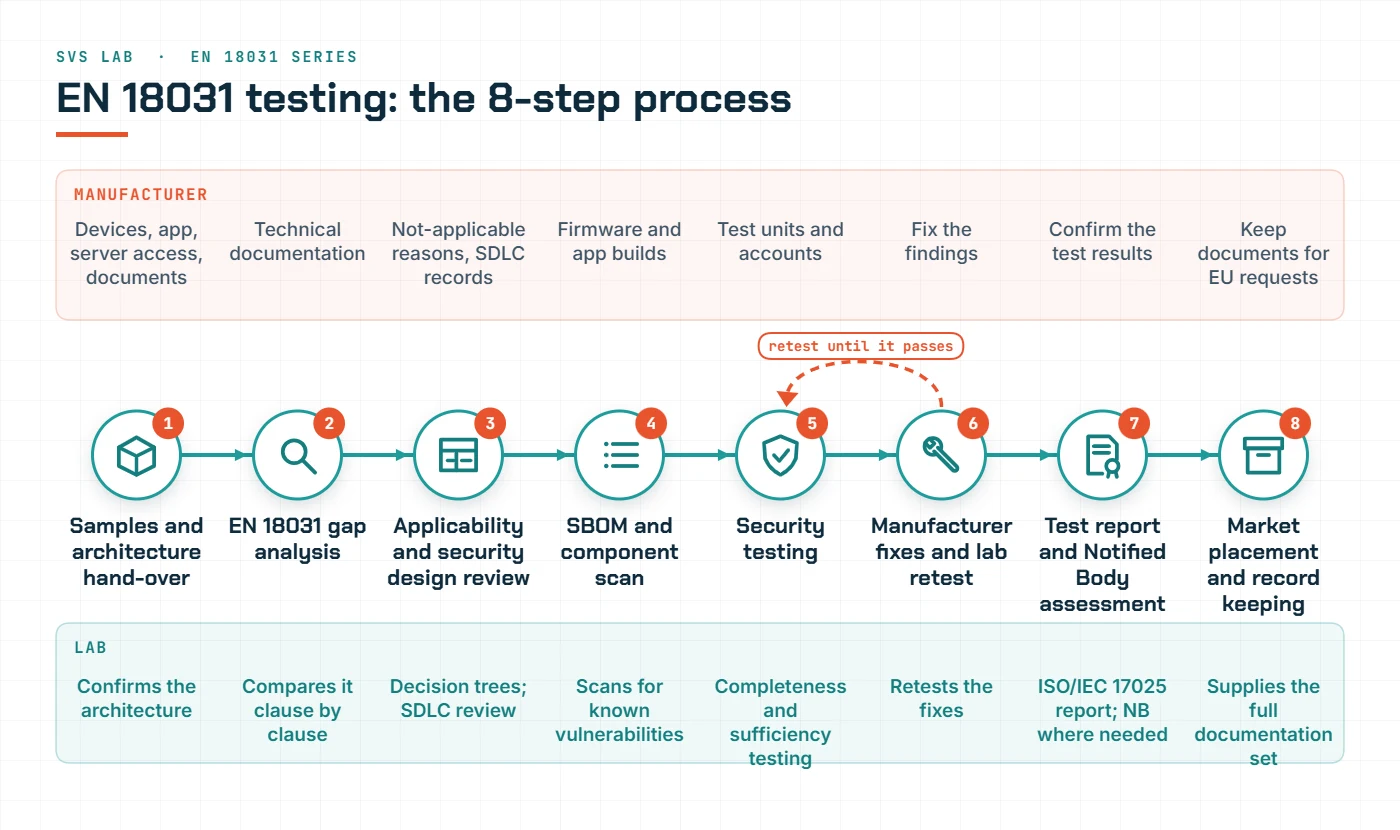
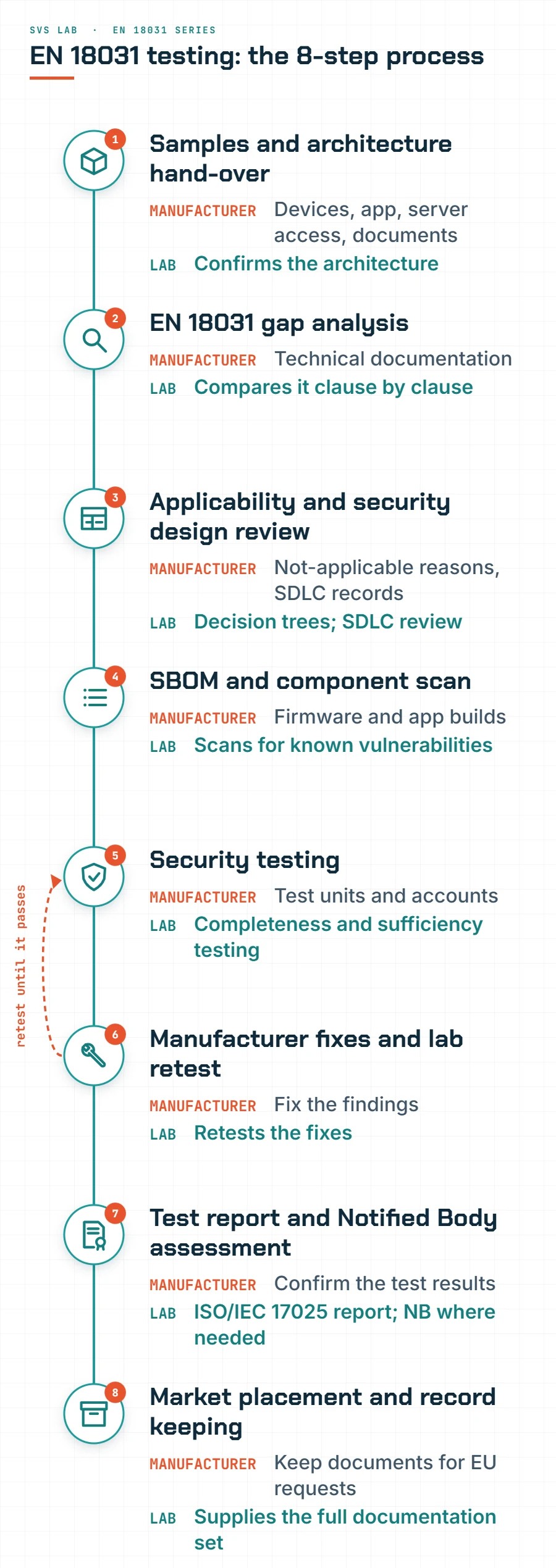
The testing process has four stages, matching the 8-step testing process on our EN 18031 testing page.
SVS LAB · EN 18031 SERIES
EN 18031 testing: eight steps
Select “Show details” under each stage to see what it involves.
PreparationSteps 1–2
Confirm which parts of the standard apply and whether the product can be self-declared or needs a Notified Body, and list the assets the product must protect: security assets such as passwords and keys, network functions, personal data and financial data. The lab then carries out a gap analysis, comparing the technical documentation with the standard clause by clause and identifying the gaps with the greatest impact first.
DocumentationSteps 3–4
Each EN 18031 requirement is assessed with the decision tree the standard provides, ending in one of three verdicts: not applicable, pass or fail. Where the verdict is “not applicable”, the manufacturer must give a reason, which the lab reviews and confirms.
Materials it helps to have ready at this stage include the decision-tree path and reasons for each requirement, secure development lifecycle (SDLC) records, the SBOM (software bill of materials) and the test samples. For the full list, see the pre-submission checklist on our EN 18031 testing page.
TestingSteps 5–6
For each requirement, the lab carries out three layers of assessment:
- On paper (conceptual assessment): do the decision-tree path and its reasoning hold?
- On the product (functional completeness assessment): do the protection mechanisms the product actually has match the documentation, with nothing missing?
- Under attack (functional sufficiency assessment): are the protection mechanisms effective, as verified through code scanning, penetration testing and similar tests?
When issues are found, the manufacturer fixes them and the lab retests. A product should not contain known exploitable vulnerabilities when it goes on the market: components with known vulnerabilities must be fixed, or assessed and confirmed as not exploitable. This stage may take several rounds of fixes and retests. For how each protection mechanism is tested, see EN 18031 Testing in Detail: The 14 Security Mechanisms and What the Lab Actually Tests.
ReportingSteps 7–8
The lab issues an ISO/IEC 17025 test report. For a self-declared product, the report goes into the technical documentation and the manufacturer signs the EU DoC. Where a restriction applies, a Notified Body then reviews the product and issues the certificate.
Keep the technical documentation and the EU DoC for 10 years after the product is placed on the market. EU authorities can ask the manufacturer, the importer or the EU authorised representative for them, and set the deadline. Failing to produce them can lead to fines or withdrawal from the market.
Steps 5 and 6: after each fix, the product goes back to security testing for a retest, until it passes.
05How long does it take?
There is no standard number of days. The timeline depends mainly on the product's architecture and how well prepared you are. The main factors are:
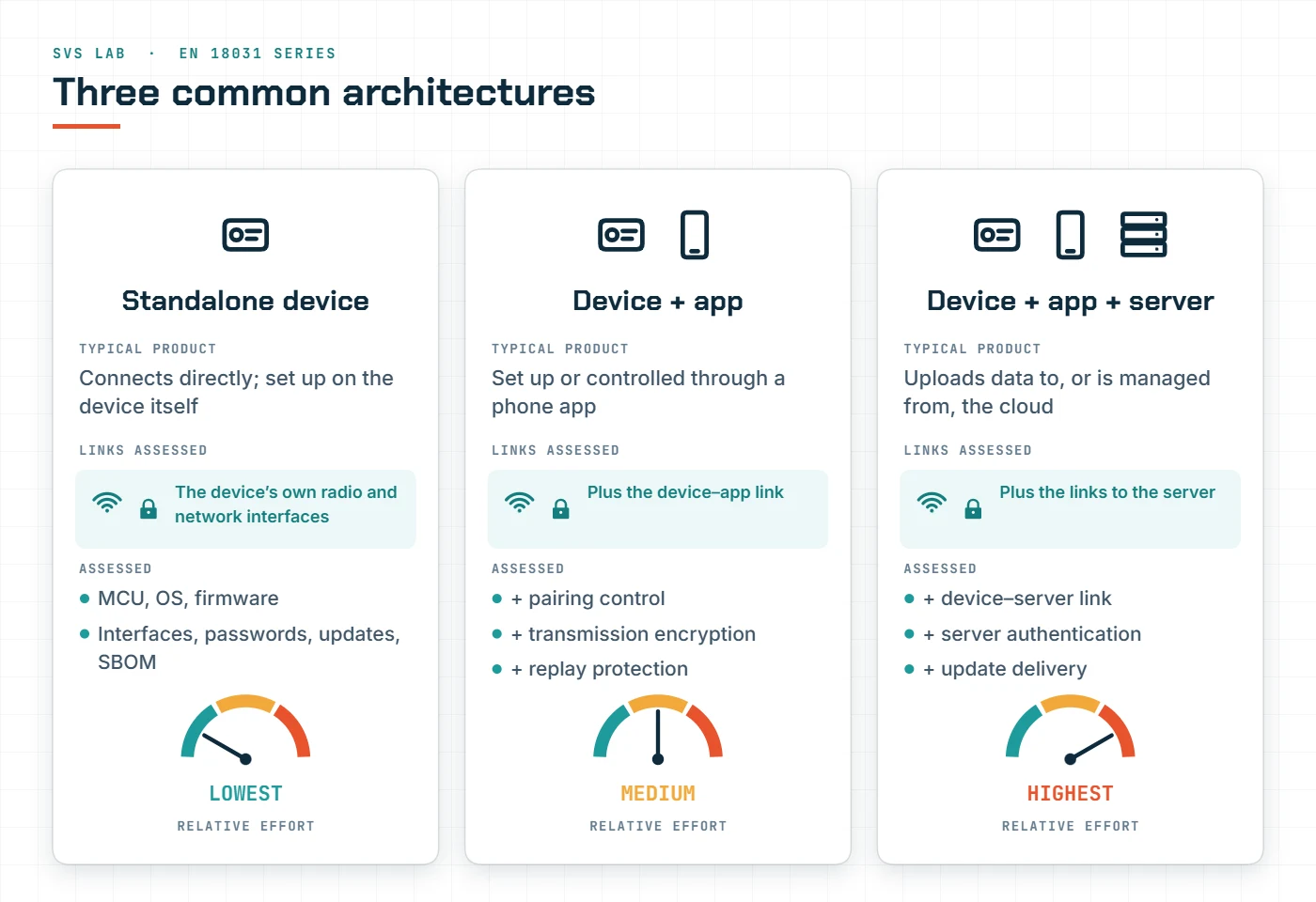
- Product architecture: a standalone device has the smallest scope; with an app and a server, the number of test items grows.
- Number of active wireless interfaces: every interface enabled at shipment must be assessed.
- Whether development records are complete: if software development was outsourced and the records cannot be obtained, the documentation stage takes longer.
- How many rounds of fixes are needed: every finding that needs correcting needs a round of retesting.
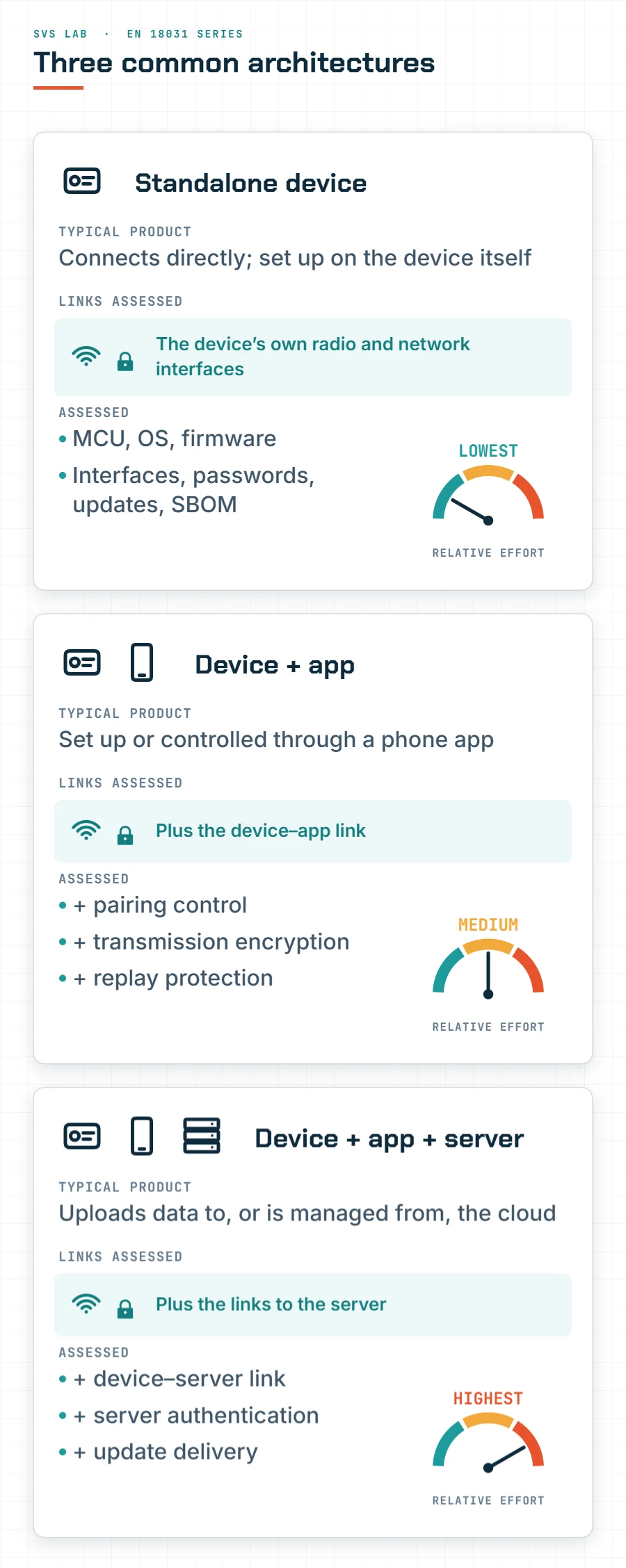
SVS LAB · EN 18031 SERIES
Three common product architectures
Select an architecture to see which links are assessed and what is covered.
Standalone device
- Typical product
- Connects to a network directly; set up on the device itself.
- Links assessed
- The device's own radio and network interfaces.
- What is assessed
- MCU, operating system, firmware; external interfaces, passwords, secure updates; SBOM and component vulnerabilities.
- Effect on timeline
- Testing concentrates on the device itself, so the relative effort is lowest.
Device + app
- Typical product
- Set up or controlled through a phone app, such as Bluetooth earbuds or smart plugs.
- Links assessed
- The device itself, plus the link between the device and the app.
- What is assessed
- Everything for a standalone device, plus pairing control (who is allowed to connect), transmission encryption and replay protection.
- Effect on timeline
- The app cannot be certified on its own; it is assessed through the device's link to it. More links mean more test items.
Device + app + server
- Typical product
- Uploads data to, or is managed from, a cloud service, such as children's smartwatches or connected cameras.
- Links assessed
- The device–app link, plus the link between the device and the server.
- What is assessed
- Everything above, plus server authentication, transmission encryption and update delivery. The focus is the link between the device and the server.
- Effect on timeline
- The widest scope, and the highest relative effort.
Ways to shorten the timeline include removing or permanently disabling interfaces and features the product does not need before it ships (the version tested must be the version sold; switching something off only on the test sample is not accepted), and starting the gap analysis early to shorten the fix-and-retest cycle.
Once you provide the product architecture and wireless interface details, the lab can provide a written test scope and timeline.
06How do you estimate the cost?
Besides the testing fee, a manufacturer doing EN 18031 for the first time usually also has to invest in product changes and documentation. Knowing the likely cost items in advance helps with budgeting.
Possible cost items
- A. Design changes: for example, switching to a unique default password per device, adding signature verification to firmware updates, or encrypting Bluetooth transmissions. This item is often underestimated and has the biggest effect on the timeline.
- B. SBOM and vulnerability scanning: building a software bill of materials, and updating or replacing components with known vulnerabilities.
- C. Technical documentation: decision-tree paths and reasons, development records, user manuals and so on.
- D. Laboratory testing: priced by test scope, including retests after fixes.
- E. Notified Body assessment: needed only for products where a restriction applies.
Factors that affect the quotation
- How many parts apply (-1, -2, -3)
- Product architecture (device, app, server)
- Whether Notified Body assessment is needed
- Number of wireless and network interfaces at shipment
- How many rounds of fixes and retests are needed
Actual costs depend on the product, and the written quotation is what counts. Once you provide the product type, wireless interfaces and architecture, the lab can provide a written test scope, timeline and quotation.
What do you receive at the end?
- A test report from an accredited laboratory. Testing is carried out in Taipei by a laboratory accredited to ISO/IEC 17025.
- A way into Notified Body assessment, where one is needed. The test report is available as supporting evidence to a Notified Body such as Applus+ Laboratories (NB 0370). The certificate is issued by the Notified Body.
- Independent evidence. A third-party report, produced to laboratory rules, for the technical documentation every CE-marked product must keep. It is also the record you will need if an EU authority asks for it (see the reporting stage in section 04).
EN 18031 and the CRA
From 11 December 2027, the EU Cyber Resilience Act (CRA) applies in full and takes over from the RED cybersecurity requirements; the EU has adopted a delegated regulation under which Delegated Regulation (EU) 2022/30 is repealed from the same date. The CRA's scope extends to most products with digital elements, including standalone software.
Some of the EN 18031 test evidence is expected to serve as groundwork for the CRA, but EN 18031 itself gives no presumption of conformity under the CRA, and the CRA adds requirements of its own, such as vulnerability handling and an SBOM. The CRA's reporting obligations have applied since 11 September 2026, including for products already on the market. Building an SBOM and a component inventory early supports preparation for both EN 18031 and the CRA. See our EU CRA hub.
Next steps
What is in scope follows from how your product is built: whether it has an app, whether it uses a server, and which interfaces it ships with. A short scoping call confirms which parts need testing and what to prepare for step 1.
Frequently asked questions
Q: Can more than one part of EN 18031 apply to the same product?
Yes. The three parts answer three different legal requirements, and those requirements add up rather than replace one another. An internet-connected product that handles personal data falls under both EN 18031-1 and -2; if it also involves money transfers, -3 applies as well.
Q: Can an app be tested against EN 18031 on its own?
No. The RED covers radio equipment, and an app on its own is not radio equipment, so there is nothing in EN 18031 to test it against; the app is assessed through the device's link to it. Standalone software comes under the CRA from 11 December 2027; software that is itself a medical device follows the medical device regulations.
Q: If a product can be self-declared, does it still need a laboratory?
The law does not require a third-party laboratory; the manufacturer can carry out the testing itself. Commissioning an ISO/IEC 17025 laboratory gives you a third-party test report for the technical documentation.
Q: Can a product whose firmware cannot be updated meet EN 18031?
Possibly. The secure update mechanism (SUM) is assessed with a decision tree. If the product genuinely cannot be updated, the manufacturer must give a reason why the requirement does not apply, and the lab reviews it. If the reason does not hold, it is recorded as a non-conformity.
For other questions, such as components with known vulnerabilities or version requirements for test samples, see the FAQ on our EN 18031 testing page.
Glossary
- RED (Radio Equipment Directive, Directive 2014/53/EU)
- The EU law for products that use radio. Its cybersecurity requirements have applied since 1 August 2025.
- Notified Body
- An independent organisation designated by an EU Member State to assess conformity. Each has a four-digit number and a defined scope, listed in the EU's NANDO database.
- EU Declaration of Conformity (EU DoC)
- The document in which the manufacturer declares that the product meets the applicable EU requirements. The manufacturer signs it in every case, with or without a Notified Body.
- EU authorised representative
- A person or company established in the EU that a manufacturer outside the EU may appoint to hold the technical documentation and answer requests from the authorities.
- ISO/IEC 17025
- The international standard for the competence of testing and calibration laboratories.
- Replay attack
- Recording a valid command and sending it again later to make the device repeat an action.
Sources
- Directive 2014/53/EU (Radio Equipment Directive, RED): obligations of manufacturers, importers and distributors
- Commission Delegated Regulation (EU) 2022/30: scope of the RED cybersecurity requirements and exclusions
- Commission Delegated Regulation (EU) 2023/2444: postponed the application of 2022/30 to 1 August 2025
- Commission Implementing Decision (EU) 2025/138: EN 18031 cited in the Official Journal of the EU, with its restrictions
- Regulation (EU) 2024/2847 (CRA)
* This article is commentary on regulation and standards, not legal advice. The actual test plan is confirmed case by case, based on the latest requirements of the authorities and the product's actual architecture and use. Whether a specific product falls within the RED must be determined case by case against the legal texts and the interpretations of the competent authorities.